
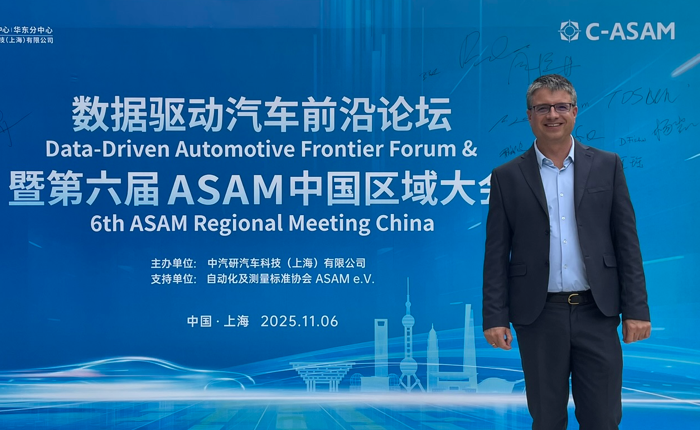
NDS Association representative Ottó Nyíró, Product Manager at the NDS Association, participated in the ASAM Regional Meeting China 2025, which took place in Shanghai, China.
During the event, Ottó delivered an NDS presentation titled Data Exchange between ASAM OpenDRIVE and NDS, offering an overview of how NDS supports data exchange with ASAM OpenDRIVE and how this integration helps bridge the gap between simulation environments and in-vehicle systems. He also highlighted the strong presence of NDS in China through its active members, including AutoNavi, NavInfo, Huawei, Tencent, Heading Data, and MXNavi, all of them playing an important role in NDS standardization and practical deployments in the region.
Ottó began by presenting the NDS.Classic and NDS.Live standards, focusing on the role of NDS.Live in modular and dynamic data distribution tailored for ADAS and automated driving. He also covered the Smart Layer Service, which enables dynamic streaming of map data such as lanes, traffic information, and road rules.
Ottó continued with the main topic of his talk — the development of the NDS ↔ OpenDRIVE Converter. To ensure consistent results across simulation and vehicle environments, map data must represent the same digital road model end-to-end. The first version of the converter was created by the NDS Association in 2017. Since 2023, the next-generation converter for NDS.Live has been under development. The new version is now mature, remains fully bi-directional, and goes beyond bench testing by supporting Docker-based service deployment, paving the way for future online integration.
The converter is available exclusively to NDS members for production use, while its documentation, including the User Guide, Developer Guide, and Release Notes is openly available to non-members for evaluation. The NDS Association is also open to discussing evaluation access for ASAM members.
ASAM OpenDRIVE remains the de facto format for simulation road models, while NDS is the leading standard for vehicle map data. The goal of the collaborative effort is to ensure that the same road model can be used consistently from closed-loop simulation to real-world driving.
Ottó also encouraged participants to explore the NDS Developer Portal, which provides access to the User Guide, schema specifications, tools such as the package builder and map viewer, reference implementations, the Python SDK for NDS.Live, sample map services for testing, and certification and validation resources.
After the presentation, Ottó took part in networking discussions focused on strengthening NDS adoption in China. The conversations highlighted the importance of global navigation standards in the Asia region, which is crucial for advancing autonomous driving and connected mobility, as well as opportunities for implementing NDS standards more widely.
You can watch a short video overview of the ASAM meeting, including main highlights, here: