
One of the core challenges in automated driving is ensuring that the vehicle operates within its defined Operational Design Domain (ODD). NDS.Live addresses this challenge by providing the location-based intelligence required for ODD awareness, helping automated driving systems remain within their operational boundaries and comply with region-specific, legal, and environmental constraints. By delivering accurate, contextual map data aligned with the vehicle’s intended path, NDS.Live supports safer and more predictable operation of ADAS and automated driving functions.

The Operational Design Domain (ODD) defines the specific conditions under which an automated driving system is intended to operate safely. As part of an informed safety strategy, ODD helps prevent system misuse by ensuring that activation occurs only within clearly defined operational boundaries, aligned with the system’s capabilities and limitations.
To define whether a specific driving automation system may operate within the given ODD, the NDS.Live specification introduces a two-component architecture. It separates decision-making from execution by combining server-side ODD management with in-vehicle evaluation.
At the off-board level, an ODD management system continuously evaluates relevant ODD attributes, using a wide range of inputs such as infrastructure data, fleet intelligence, and human supervision where needed. Based on this input, the system assigns a simplified clearance status, either ALLOWED or PROHIBITED, to specific map features such as roads, lanes, or display lines. These clearance decisions are then delivered to the vehicle via the NDS.Live Rules module.
Within the vehicle, automation systems interpret these clearances as part of their activation logic. If a map feature is marked as PROHIBITED, the system must not be activated under any circumstances. If marked as ALLOWED, the vehicle proceeds with its own sensor-based safety validation before enabling the function.
This approach is illustrated in the following figure:
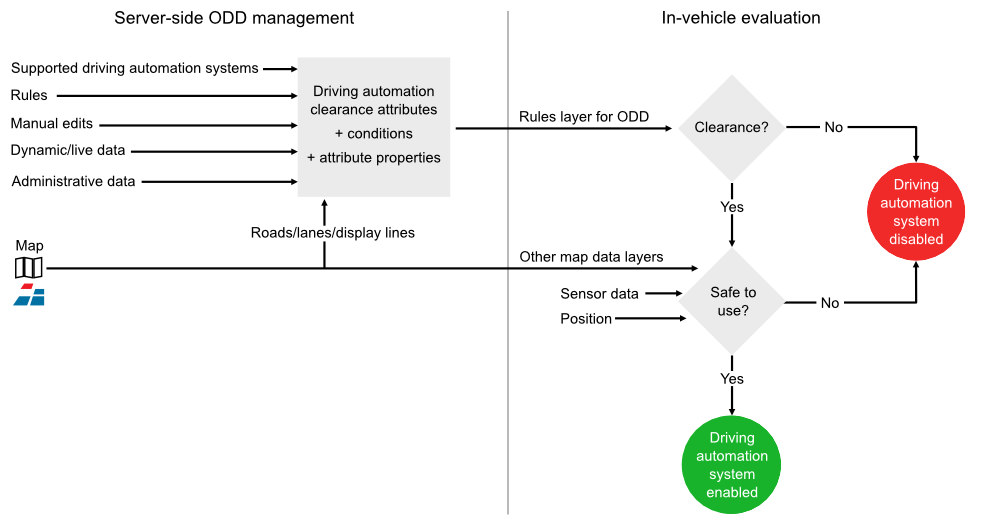
By shifting ODD evaluation off-board, NDS.Live significantly reduces the complexity of in-vehicle logic and minimizes bandwidth requirements. Vehicles no longer need to process raw ODD data or interpret environmental constraints independently; instead, they receive pre-evaluated clearance decisions that can be applied directly within their operational context.
Off-board systems also benefit from access to data sources unavailable to the vehicle itself, such as real-time infrastructure inputs or aggregated fleet insights. This enables proactive identification of ODD boundary violations, for example, due to temporary road closures or adverse weather.
Furthermore, sensor data collected by individual vehicles can be fed back into the ODD management system, contributing to a continuously improving ecosystem that enhances situational awareness across the fleet.
At the core of this architecture lies the DRIVING_AUTOMATION_CLEARANCE attribute, defined within the NDS.Live Rules module. This mechanism enables the assignment of automation permissions directly to map features, with flexible granularity ranging from general clearance per feature to system-specific permissions.
Clearances may also be conditional, allowing activation rules to depend on contextual factors such as time of day or day of the week. For example, a motorway chauffeur function could be permitted only during off-peak hours or restricted in reversible lanes during specific time windows without requiring frequent updates to the underlying map data.
Attribute properties (optional metadata per clearance):
The NDS.Live specification defines clearance compatibility for over 26 standardized driving automation systems spanning SAE Levels 0 to 4.
In addition to these predefined systems, the specification supports custom system identifiers, enabling OEMs to integrate proprietary automation functions within the same standardized framework. Custom system identifiers are available to support proprietary or future driving automation functions within the standardized NDS.Live framework.
NDS.Live remains agnostic to how ODD clearance decisions are derived whether based on rule-based logic, AI-driven analysis, or human-in-the-loop validation. As automated driving systems move toward broader deployment, effective and scalable ODD management becomes essential for ensuring safe and reliable operation. By standardizing the interface between off-board ODD evaluation systems and in-vehicle automation logic, NDS.Live enables a flexible yet robust framework for delivering clearance-based activation decisions aligned with real-world conditions.
To explore how NDS.Live supports ODD-aware driving automation and to begin integrating these capabilities into your development workflow, join the NDS Developer Portal and access the latest specification resources and implementation guidelines.
Back to news →